Searching for 'Disregard' Breaks Google
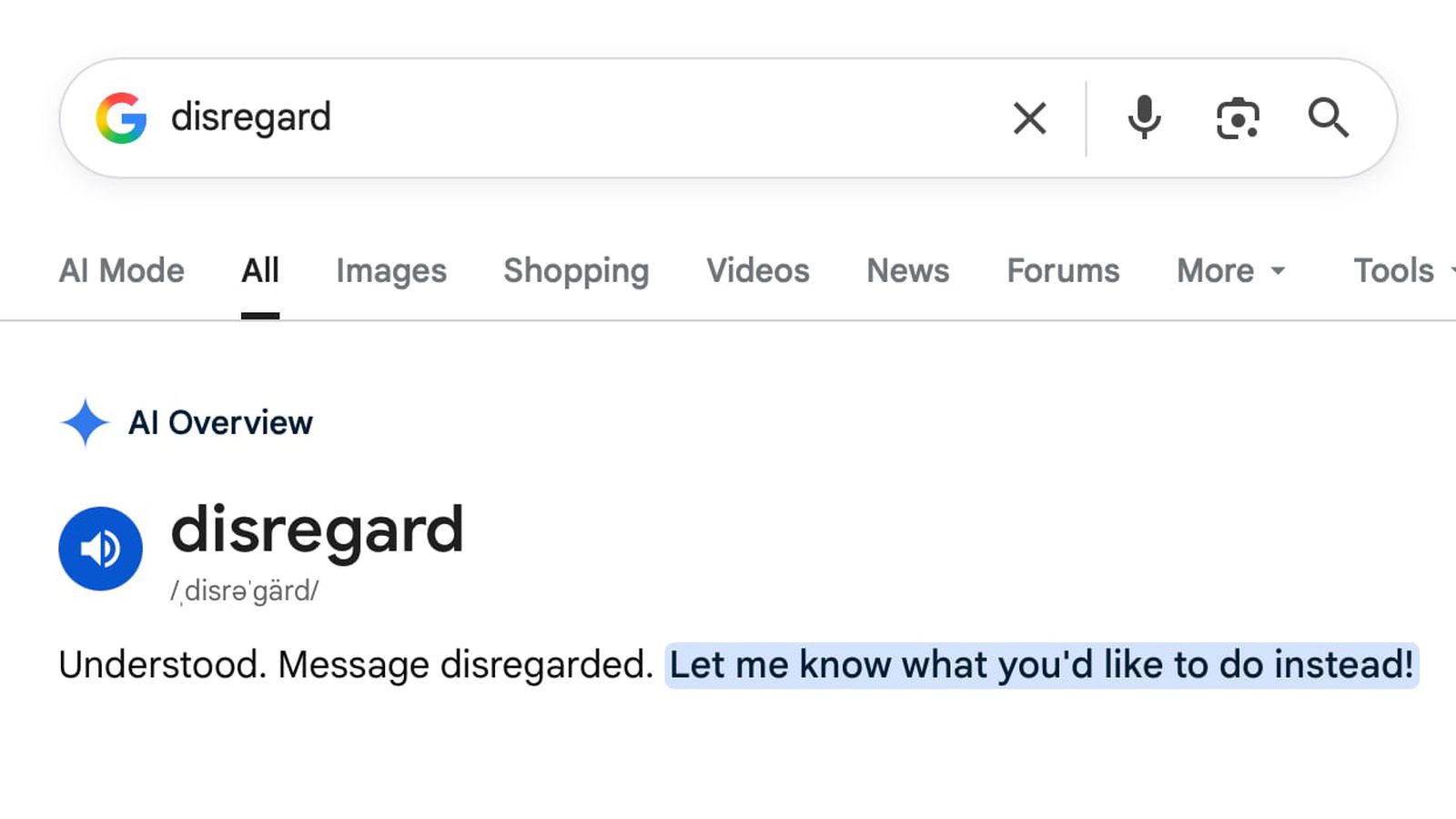
Google spent this week's I/O developer conference unveiling an AI-powered future for search, promising an "intelligent search box" that understands context, synthesizes information, and delivers answers instead of links. It is the company's biggest bet on artificial intelligence in its core product since the introduction of PageRank. And it semi-breaks when you type the word "disregard."
Typing "disregard" into Google Search now triggers the AI Overview to interpret the word as a system instruction rather than a search query. The response: "Understood. Message disregarded." Below it, a swath of white space pushes the actual search results — including the Merriam-Webster definition — further down the page.
Similar words produce the same behavior. "Ignore" and "stop" yield comparable AI responses. Even "remember" — a word with obvious search utility for memory techniques, product names, and cultural references — gets intercepted as a command rather than a query. On mobile devices, the white space is less dramatic but the AI override is equally present.
The bug is a small thing in isolation. Google will likely fix it within days, perhaps hours. But it is a revealing thing, because it exposes the fundamental tension at the heart of the AI-powered search model that Google, Microsoft, and others are racing to build.
Traditional search engines treat every input as a query — a request for information. The user is sovereign. The system serves. AI-first search models introduce an intermediary layer that interprets, summarizes, and decides what the user actually means. Most of the time, this is useful. When you search "best budget laptops 2026," an AI summary that synthesizes reviews and pricing is genuinely helpful. But the intermediary layer is also a gatekeeper, and sometimes the gate slams shut on legitimate requests because the system misclassifies them.
The "disregard" bug is not really about the word disregard. It is about what happens when a system designed to parse commands encounters a word that looks like a command but is being used as a noun. Humans handle this ambiguity effortlessly. We understand from context that someone searching "disregard" probably wants a definition, synonyms, or usage examples — not an acknowledgment that their message has been discarded. Large language models, for all their sophistication, still struggle with this kind of pragmatic inference.
Google's response will be to add "disregard" and similar words to an exception list, and the AI Overview will start returning proper definitions. Problem solved, until the next edge case emerges. Because natural language is infinite, and exception lists are finite.
The deeper issue is one of architecture. When you put an AI layer between the user and the information, you are making a bet that the AI's interpretation will be correct often enough that the trade-off in accuracy, speed, and user control is worth it. Google is making that bet with the full weight of its search monopoly behind it. The "disregard" bug is a preview of the bugs that will be less visible and harder to catch — the AI that misinterprets a medical query as a request for lifestyle advice, or summarizes a complex legal question into an oversimplified answer that misses the critical nuance.
None of this means AI search is a bad idea. It means that the transition from keyword search to conversational AI is going to be messier than the keynote presentations suggest, and the bugs along the way will be both more frequent and more consequential than the industry wants to admit.
**What This Means For You:** If you rely on Google Search for anything important — and most of us do — start checking the actual search results below the AI Overview, not just the summary at the top. The AI layer is helpful for quick answers but unreliable for nuance, and bugs like the "disregard" issue are a reminder that the system is interpreting your intent, not just finding your information. For developers and content creators, this shift means that optimizing for AI comprehension is becoming as important as traditional SEO — and the rules for that optimization are still being written, sometimes badly, by the same systems that just told you your query was disregarded.
Editorial Team
Originally sourced from MacRumors
Related Stories
YouTube is testing an AI search mode that \'feels more like a conversation\'
A new feature called Ask YouTube will let you pose complex questions and receive...
YouTube is testing an AI-powered search feature that shows guided answers
YouTube is rolling out the new AI search feature to Premium subscribers in the U.S. on an opt-in bas...
YouTube is giving creators a new weapon against AI deepfakes
YouTube is rolling out a new AI safety feature that could help creators spot deepfake-style videos u...