founder Karpathy joins Anthropic pre
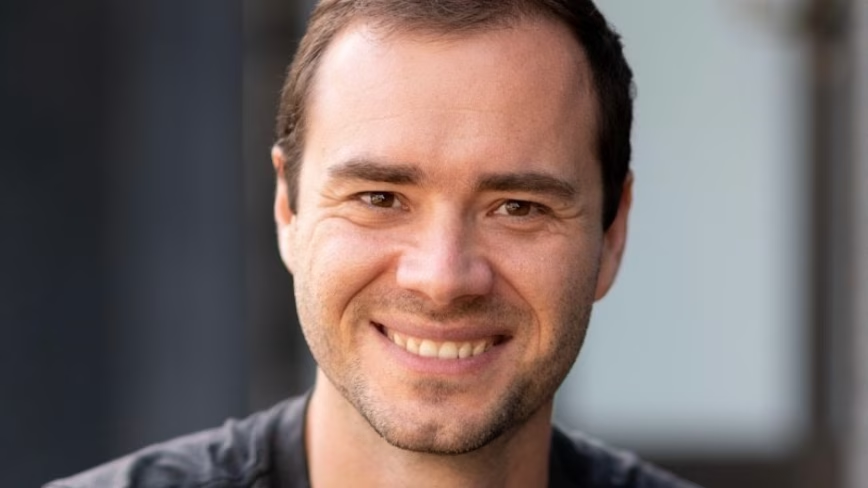
# Andrej Karpathy Joins Anthropic: What the OpenAI Co-Founder's Move Means for the AI Race
Andrej Karpathy, one of the most influential figures in artificial intelligence, has joined Anthropic — the AI safety company founded by former OpenAI researchers who left over concerns about the pace and direction of AI development. The move sends shockwaves through an industry already gripped by fierce competition for talent, and it raises urgent questions about where the center of gravity in AI research is shifting.
## Who Is Andrej Karpathy and Why This Matters
Karpathy isn't just another engineer jumping between companies. He was a founding member of OpenAI in 2015, served as Tesla's Director of AI during the critical years when Autopilot was being developed, and then returned to OpenAI in 2023 to lead research on large language models. He left OpenAI again in February 2024 to start Eureka Labs, an AI-focused education company.
His decision to join Anthropic — rather than return to OpenAI, join Google DeepMind, or build his own foundation model company — is a signal. Karpathy has consistently advocated for careful, transparent AI development. Anthropic, founded on the principle that AI systems should be steerable, honest, and safe, aligns more closely with that philosophy than OpenAI's current trajectory under Sam Altman, which has increasingly prioritized product deployment speed and commercial partnerships.
At Anthropic, Karpathy will build a new team focused on using Claude — Anthropic's flagship AI model — to accelerate AI research itself. This is the "AI for AI" approach: using advanced models to help researchers write better code, design experiments faster, and reason about complex problems. It's the same vision Karpathy pursued at Eureka Labs, but now with the resources and compute infrastructure of a well-funded frontier lab.
## The Talent War Intensifies
Karpathy's move is the latest in a series of high-profile defections that have reshaped the AI landscape. Key researchers have flowed between OpenAI, Google DeepMind, Anthropic, and Meta with increasing frequency over the past two years. The competition isn't just about money — though compensation packages for top AI researchers routinely exceed $10 million annually. It's about philosophy, culture, and which organization researchers believe will produce the most important work.
OpenAI has lost several senior researchers to Anthropic in recent months, and the trend appears to be accelerating. While OpenAI still employs over 1,700 people and has the largest share of mindshare in consumer AI, the brain drain is real. Researchers who leave often cite discomfort with OpenAI's transition from a nonprofit research lab to a for-profit corporation valued at $300 billion, and concerns that safety considerations are being subordinated to shipping products.
Anthropic, by contrast, has positioned itself as the "responsible" frontier lab. Whether that positioning reflects genuine commitment or effective branding is a matter of debate within the AI community. But for researchers like Karpathy, who have publicly argued that AI development needs more guardrails, Anthropic offers a more credible home.
## What This Means for the Broader AI Industry
The implications extend beyond corporate rivalries. Karpathy's move highlights three structural trends shaping AI in 2026:
**First, the "AI for AI" research paradigm is becoming central.** Using AI models to improve AI models — recursive self-improvement, in simplified terms — is no longer a theoretical concept. It's the active research direction at multiple labs. If Anthropic can use Claude to make Claude better, faster, the compounding effects could be enormous. Karpathy's expertise in training infrastructure and large-scale model development makes him uniquely suited to lead this effort.
**Second, safety-first AI is becoming a competitive advantage, not just a constraint.** Anthropic's Claude models have gained significant market share in enterprise settings specifically because of their safety features — lower hallucination rates, better refusal of harmful requests, and more predictable behavior. Companies building AI into products where reliability matters — healthcare, legal, financial — increasingly prefer Claude. Karpathy's arrival strengthens that positioning.
**Third, the concentration of AI talent in a handful of organizations continues to accelerate.** Despite the proliferation of open-source models and smaller AI startups, the fundamental research that determines the trajectory of AI development is still done by a small number of people at a small number of labs. When one of the top ten most influential AI researchers changes teams, it shifts the balance of power in ways that affect every downstream application.
## What This Means For You
If you're following AI developments for investment or career decisions, this move matters more than most product launches. Karpathy at Anthropic means the "AI safety" camp just got significantly more technical firepower, which could slow the rush toward deploying untested AI systems in high-stakes environments. For businesses evaluating AI tools, Anthropic's strengthening research team suggests Claude will continue improving rapidly — and if safety and reliability are important to your use case, that's worth factoring into your procurement decisions. For workers in AI-adjacent fields, the trend is clear: the companies that will define the next decade of AI are still consolidating talent, and the race is far from over. The safest career bet remains building skills that complement AI rather than compete with it — exactly the kind of creative, judgment-heavy work that Karpathy himself has said AI will struggle to replace for years to come.
Editorial Team
Originally sourced from TNW
Related Stories
YouTube is testing an AI search mode that \'feels more like a conversation\'
A new feature called Ask YouTube will let you pose complex questions and receive...
YouTube is testing an AI-powered search feature that shows guided answers
YouTube is rolling out the new AI search feature to Premium subscribers in the U.S. on an opt-in bas...
YouTube is giving creators a new weapon against AI deepfakes
YouTube is rolling out a new AI safety feature that could help creators spot deepfake-style videos u...