Trump administration prepares for proposed $250 bill with the president’s face on it
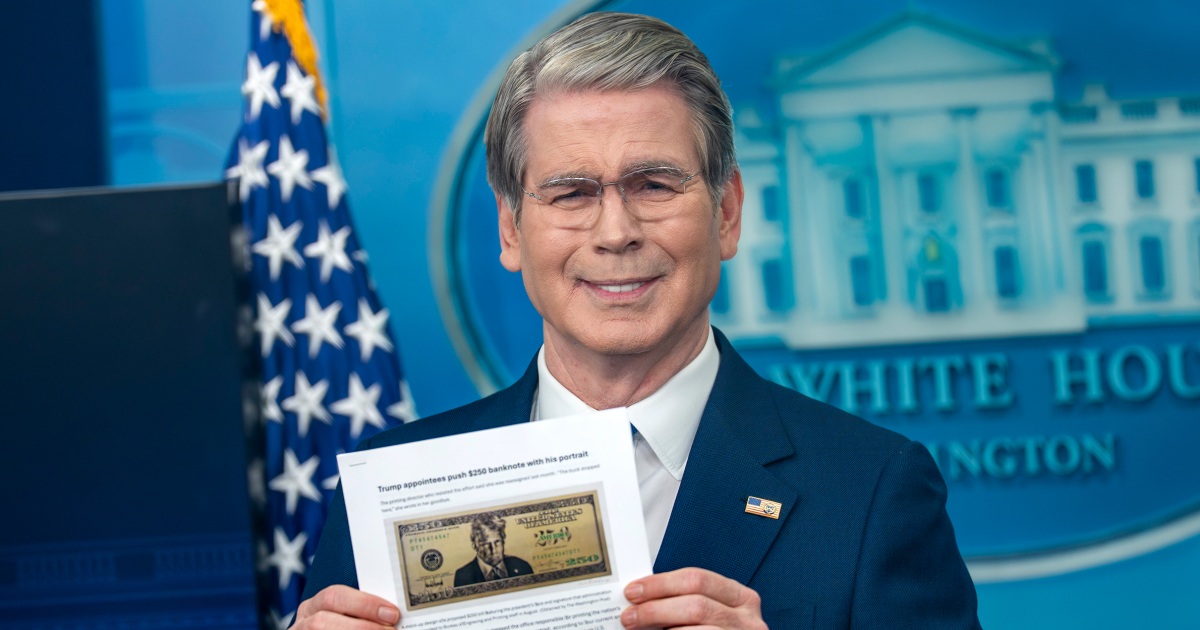
The Treasury Department is already preparing to print $250 bills featuring President Donald Trump's face, Treasury Secretary Scott Bessent confirmed during Thursday's White House press briefing. The only thing standing between the proposal and the printing press is an act of Congress.
Bessent said the Bureau of Engraving and Printing is conducting appropriate planning and due diligence and moving proactively to produce the bill should legislation be signed into law. The proposed legislation, introduced by Rep. Joe Wilson of South Carolina, would change the longstanding rule that no living person can appear on U.S. currency — a rule specifically designed to prevent the kind of monarch-like personality cult that the Founders explicitly wanted to avoid.
The $250 denomination itself is unusual. The U.S. has not issued a bill larger than $100 since 1969, when the $500, $1,000, $5,000, and $10,000 notes were discontinued over concerns about their use in money laundering and tax evasion. A $250 bill has never existed in American currency. The denomination appears to have been chosen to coincide with the nation's 250th anniversary in 2026, though the symbolism of putting a living president on a denomination that has never existed is hard to ignore.
Bessent framed the initiative as part of the upcoming semiquincentennial celebrations, comparing it to other commemorative efforts. I don't think that there's anything untoward about having the president of the United States, the person who was president of the United States on the 250th anniversary bill, he told reporters. But the timing and context make it impossible to view this in isolation. The $250 bill proposal is one piece of a broader pattern of efforts to affix Trump's name and likeness to the federal government in ways no previous president has attempted.
In March, the Treasury announced that Trump's signature would appear on paper currency — another first for a sitting president. A federal commission of Trump-appointed members has approved a design featuring Trump's image on 24-karat commemorative gold coins, still awaiting official Treasury approval. Beyond currency, Trump has affixed his name to the Kennedy Center for the Performing Arts, the U.S. Institute of Peace, a discount drug program, proposed savings accounts, and even proposed warships.
The constitutional and normative concerns are significant. The prohibition on living persons appearing on U.S. currency dates to 1866, when Congress passed legislation stating that no portrait of any living person shall be placed on any bond, security, or other currency of the United States. The rule was a direct response to the practice of putting contemporary politicians on money, which the post-Civil War Congress viewed as a corruption risk and an unseemly expression of power. Removing that prohibition for a sitting president — the very scenario the rule was designed to prevent — would represent a fundamental break from 160 years of precedent.
The political dynamics are equally telling. Wilson's bill was referred to the House Financial Services Committee in February 2025 and has not moved since. A Wilson spokesperson said the congressman has spoken with committee chair Rep. French Hill about advancing the legislation and has discussed it with Bessent and Trump on multiple occasions. Even in the current Congress, where Republicans hold narrow majorities, the bill faces an uncertain path — but the Treasury's decision to begin production planning before legislation has passed suggests the administration views the outcome as a foregone conclusion.
What This Means For You: A $250 bill with Trump's face on it would be historically unprecedented in two ways — the first living person on U.S. currency and the first $250 denomination. Whether you see it as a fitting tribute to the president during America's 250th anniversary or an uncomfortable departure from democratic norms depends largely on your politics. But the broader pattern is worth paying attention to: the normalization of a sitting president's personal brand being woven into government institutions, from currency to cultural institutions to military hardware, represents a shift in how the federal government presents itself to its citizens. This isn't just about a piece of paper. It's about what that paper represents, and who gets to decide what goes on it.
Senior Political Correspondent
Originally sourced from NBC News
Related Stories
Woman, Her 5 Children Released From Longest ICE Detention of a Family Under Trump
A woman and her five children have been released from Immigration and Customs Enforcement custody af...
Wildfires Abound in US Southeast, Georgia Suffers Record Property Losses
Wildfires are tearing through the US Southeast at an alarming pace, with Georgia hit especially hard...
Why fighting federal-benefit fraud must top the Republican agenda
Expect the fight against fraud to dominate the Republican agenda in Congress and on the campaign tra...