This Battery-Free Sweat Patch Tracks Your Health for 21 Days Straight
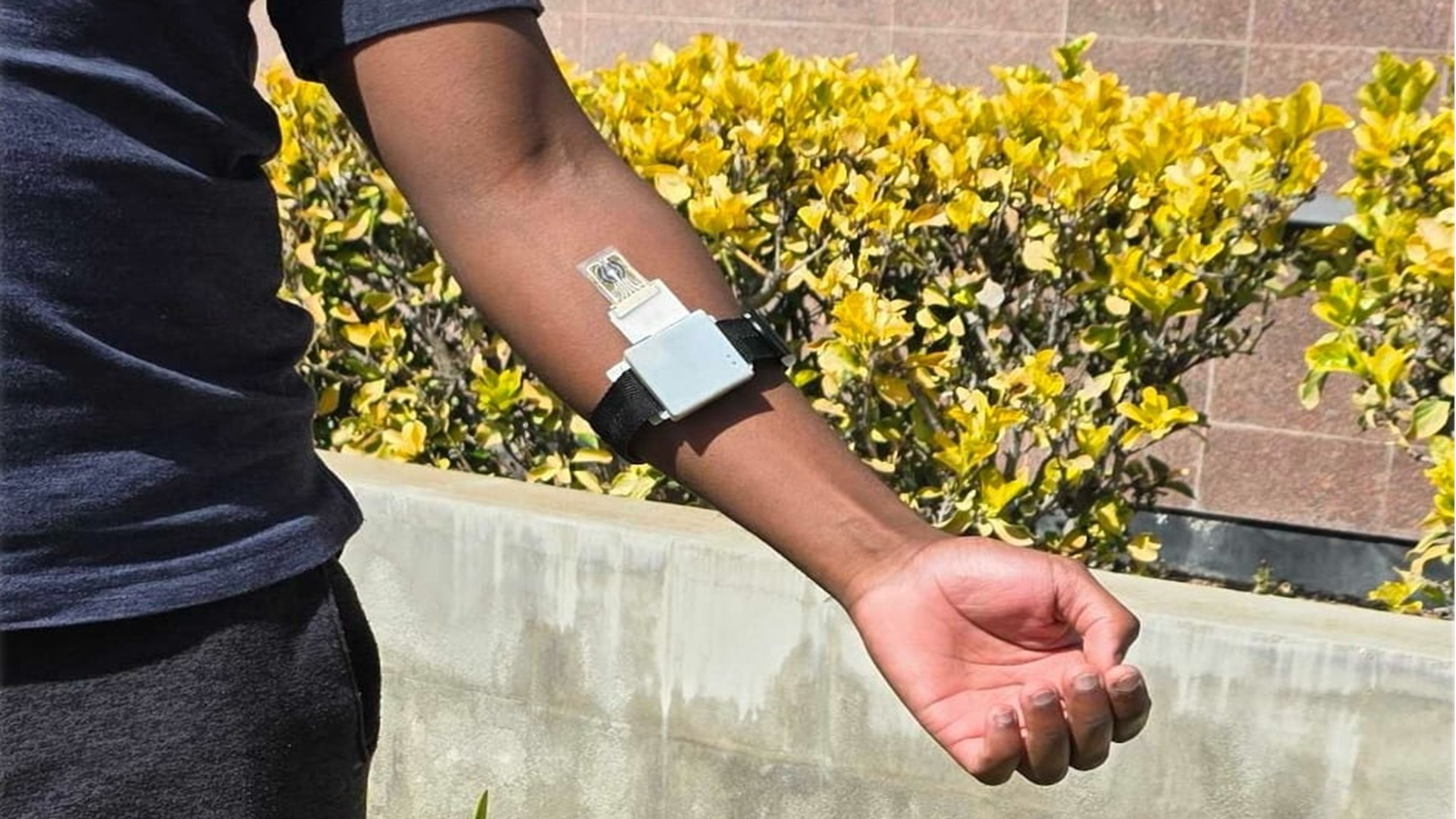
Wearable health monitors have a persistent problem: they work great for a few days, then the sensors degrade and the readings get unreliable. A new device from researchers at the University of California, Irvine, aims to solve that — and it doesn't even need a battery.
The device is called IREM-W2MS3, which stands for In-Situ Regeneratable, Environmentally Stable, Multimodal, Wireless, Wearable Molecular Sweat Sensing System. It's a flexible skin patch that analyzes sweat in real time, measuring four key health biomarkers simultaneously: cortisol, glucose, lactate, and urea.
The research was published in Nature Biomedical Engineering, and the team has filed a patent through UC Irvine's Beall Applied Innovation office.
## How It Works
The patch sits on your skin and draws power wirelessly through near-field communication — the same technology that lets you tap your phone to pay at a register. A smartphone or a small wrist-worn reader creates an electromagnetic field that powers the sensor. No battery, no charging cable, no bulky power source.
This is a meaningful design choice. Batteries are the heaviest, bulkiest, and least reliable component in most wearables. They degrade, they run out, and they need to be recharged. By eliminating the battery entirely, the IREM system removes the biggest point of failure in continuous health monitoring.
## The Self-Cleaning Breakthrough
The key innovation is the regenerating sensor surface. Every wearable biosensor faces the same enemy: biofouling. Over time, molecules accumulate on the sensing layer, reducing accuracy until the device becomes unreliable. Most sweat sensors last a few days before they start drifting.
The IREM system solves this by applying a low voltage pulse to refresh its own sensing layer, stripping away accumulated molecules and restoring the sensor to near-original performance. Think of it like a self-cleaning oven, but for molecular detection.
"The regenerative capability addresses one of the biggest obstacles in long-term wearable biosensing, which is sensor surfaces that lose performance after repeated measurements because molecules remain bound to the sensing layer," said Rahim Esfandyar-Pour, the senior author of the study.
The device was tested continuously for 21 days without measurable signal degradation — a dramatic improvement over existing wearables, which typically show significant drift after 3 to 7 days.
## Four Biomarkers, One Patch
Most commercial wearables track one or two metrics, usually heart rate and blood oxygen. The IREM system simultaneously monitors four biomarkers through sweat:
- **Cortisol:** The stress hormone. Chronically elevated cortisol is linked to anxiety, depression, weight gain, and immune suppression. Continuous tracking could help people understand their stress patterns in a way that a single blood test cannot. - **Glucose:** The sugar fuel indicator. While not a replacement for blood glucose monitors used by people with diabetes, sweat glucose tracking could offer early warning of metabolic changes. - **Lactate:** A marker of physical exertion and tissue oxygenation. Athletes already use lactate threshold testing to optimize training; continuous tracking could make that accessible to anyone. - **Urea:** A kidney function indicator. Elevated urea in sweat correlates with kidney stress, making this potentially valuable for monitoring patients with chronic kidney disease without repeated blood draws.
Because the measurement is non-invasive — it's reading your sweat, not your blood — the system could support continuous monitoring in daily life without clinical visits or needles.
## Generating Sweat Without Exercise
One of the more practical innovations is the ability to induce sweat on demand. Most sweat sensors require the wearer to exercise or be in a hot environment to produce enough sweat for measurement. That limits when and how often readings can be taken.
The IREM system uses a hydrogel that can be activated through wireless energy transfer, stimulating sweat production locally under the patch. This means the device can take readings whether you're running a marathon or sitting at your desk.
## What This Means for You
**This isn't on shelves yet.** The device is a research prototype, not a commercial product. UC Irvine has filed a patent and the team is working toward commercialization, but the timeline from lab to wrist is typically 2 to 5 years for medical devices.
**The self-cleaning sensor concept is the real breakthrough.** If the regeneration approach holds up at scale, it could be applied to far more than just sweat sensors. Any biosensor that degrades over time — continuous glucose monitors, drug delivery patches, infection detection wearables — could benefit from a self-refreshing sensing surface.
**For people managing chronic conditions,** a 21-day continuous monitor that tracks stress, metabolism, exertion, and kidney function without needles or batteries could be genuinely life-changing. It would give doctors and patients a continuous data stream instead of isolated snapshots, enabling earlier intervention and more personalized treatment.
**For athletes and fitness enthusiasts,** real-time lactate and cortisol tracking could replace expensive lab-based testing with a skin patch that costs a fraction of current monitoring equipment.
**The bigger trend is clear:** wearable health technology is moving from simple activity tracking toward genuine medical monitoring. The IREM system is one of several emerging devices that measure molecular biomarkers rather than just motion and heart rate. As these sensors get smaller, cheaper, and longer-lasting, the line between a fitness tracker and a medical device will continue to blur — and that shift has implications for how we practice preventative medicine, manage chronic disease, and understand our own bodies in real time.
This article draws on reporting from Interesting Engineering and the study published in Nature Biomedical Engineering.
Editorial Team
Originally sourced from Core News Daily
Related Stories
Juvenile Shot in Vehicle Incident in Randolph County Highlights Gun Safety Concerns
COLUMBIA, Mo. (KMIZ) A juvenile had non-life-threatening injuries after they were accidentally shot ...
Your Android Camera Can Do Much More Than Take Photos — Here\'s What You\'re Missing
With the right apps, your Android camera becomes a health monitor, food scanner, accessibility tool,...
Young country music star's scary condition can kill her instantly: 'You're just gone'
The 28-year-old has been open about her health diagnosis....