"120 Quadrillion Tokens Monthly By 2030": Goldman's Deep Dive Into The Coming Agentic Economy
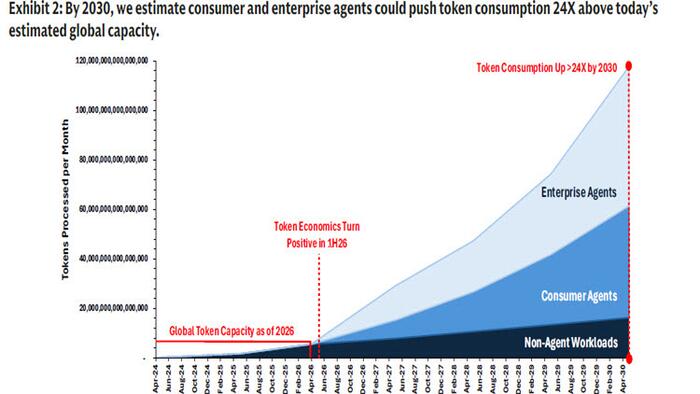
Goldman Sachs is painting a picture of the AI economy that makes current spending levels look like a warm-up act. In a new research report titled "Decoding the Agentic Economy," the bank projects that token consumption — the fundamental unit of AI compute — could reach 120 quadrillion tokens per month by 2030, a 24-fold increase from today. By 2040, the numbers get even more staggering.
The shift from generative AI to agentic AI is the driver. While today's AI tools mostly answer questions and generate content in response to human prompts, agentic AI systems act autonomously — planning, executing, and iterating on multi-step tasks without continuous human oversight. That difference in capability translates directly into dramatically higher compute consumption, because agents run continuously rather than in short conversational bursts.
Goldman breaks the growth into two streams. Enterprise agents will be the largest token multiplier, driving a 55-fold increase in consumption by 2040 as companies deploy autonomous systems for everything from customer service to supply chain optimization to financial analysis. Consumer agents will broaden usage from episodic chats to persistent digital assistants that handle tasks throughout the day, driving a 12-fold increase by 2030.
The implications for infrastructure investment are enormous. If Goldman's projections are even roughly correct, the data center build-out currently underway — already described by CBRE as potentially rivaling the railroad expansion of the 1850s — may still be undersized relative to what the agentic economy will demand. Token consumption at this scale requires not just more data centers but more power generation, more cooling capacity, more networking bandwidth, and more advanced chip manufacturing.
The report also quantifies the potential upside to business outcomes from agentic AI adoption, along with the investment levels required to capture that upside. Goldman's trade recommendations focus on the infrastructure layer — the companies building the physical backbone that makes agentic AI possible — as the highest-confidence way to bet on this trend.
But Goldman also acknowledges the risk that comes with the agentic vision. "Agentic AI could be misdirected and counterproductive, consuming vast resources with little return," the bank warns. The gap between the theoretical capability of autonomous AI agents and their practical reliability remains significant. Early deployments have shown that agents can get stuck in loops, make cascading errors, or simply fail at tasks that seem straightforward.
The 120 quadrillion token figure is also worth scrutinizing. That level of consumption implies an energy footprint that could strain power grids and test the limits of current chip manufacturing capacity. It also raises questions about cost — if token consumption grows 24x but efficiency improvements only reduce per-token costs by, say, 10x, the net cost of AI compute still rises dramatically.
What makes Goldman's projection credible is the structural argument: agentic AI changes the unit economics of AI usage from "per query" to "per task," and tasks are inherently more compute-intensive than queries. A single agent handling a complex workflow might consume as many tokens in one session as a user generates in a month of casual ChatGPT use.
The race to build agentic AI infrastructure is already well underway. The companies that control the compute layer — chipmakers, cloud providers, and data center operators — stand to benefit regardless of which specific AI companies win the model-level competition.
**What This Means For You:** If you're an investor, Goldman's report reinforces the thesis that AI infrastructure — chips, power, cooling, data centers — is the safer bet than any individual AI software company. If you're a business leader, the agentic AI shift means you should start thinking about AI not as a tool your employees use, but as a workforce that works alongside them — and plan your technology and talent strategies accordingly. If you work in a role that involves repetitive multi-step processes, agentic AI is coming for your workflow within the next few years. The question is whether you'll be the person deploying these agents or the person being replaced by them.
Finance & Markets Editor
Originally sourced from ZeroHedge
Related Stories
Young Voters Squeezed by Economy, Distrust in Political System: Poll
A new Harvard Youth Poll paints a sobering picture of the economic and political landscape facing yo...
World shares are mixed and oil prices jump more than 3% after the UAE says it will exit OPEC
World shares are mixed following a retreat on Wall Street, and oil prices gained on Iran war uncerta...
Will the Economy Cost Republicans the Midterms? New Poll Shows Troubling Signs
A new Fox News poll released this week delivers a sobering message for Republicans heading into the ...